Try increasing gamma if dark sections aren't distinguished

Try increasing gamma if dark sections aren't distinguished

Wednesday, September 27, 2023

Lunar Rays

Lunar rays, streaks of debris radiating out from craters, are among the few structures better seen during a full moon than a partial phase

Technically, there are 2 other types of lunar rays:

1. rays of light shining through a break in a lunar mountain range/crater during lunar sunrise.  these esoteric phenomena are challenges for advanced lunar observers and difficult to catch. 

2. a bunch of dudes named Ray something...(sorry)

The massive ray structure around tycho (lower right below) is easily seen though binoculars:

massive lunar rays surrounding tycho (right below center)
copernicus and kepler (middle, below center) 
full moon 11/27/12

The butterfly pattern around crater proclus suggests a low angle impact:

lunar rays around crater proclus
8/29/2023 06:42 UTC
(click for full size)
top full moon picture above

Menelaus and rays
8/29/23 06:59 UTC
(click for full size)
upper mid left full moon image

craters messier a and b are thought to have formed by a single  impacting body coming in at a very low angle:

Messier A and B
8/29/23 06:48 UTC
upper right full moon image

Here's a mosaic of craters copernicus and kepler and surrounding rays.  (left the rough edges for the mosaic feel).  click for a moon walk:  

Copernicus and Kepler
9 panel mosaic
8/29/23 07:05-07:17 UTC
(click for massive size)

Imaging details:

the full moon is usually the bane of astrophotographers
in accordance with murphy's law
it took me months to capture images during a full moon when i actually wanted to due to cloud cover.  

camera ZWO ASI 290MM with 850 nm IR pass filter
celestron 11" Edge HD
mediocre seeing
8/29/23 06:41-07:17 UTC
lunar waxing gibbous 12.5 days old

East Bluff, CA
captured in fire capture
stacked in autostakkert
light wavelets in registax
mosaic in maxim (tried and true worked amazingly well)
photoshop
topaz denoise worked wonders for slight noise reduction and dramatic detail recovery
(first sharpening has ever worked well for me in topaz)
low light
remove noise 1
enhance sharpness 63

full disk
11/27/12
FS 102, SX H9 (probably)

Saturday, September 23, 2023

saturn opposition 2023

managed to have clear skies, decent seeing and the next morning off enabling me to catch saturn at the exact time of opposition and within minutes of local transit:

Saturn 8/27/23 08:16 UTC
Eastbluff, CA

here's a wider view with the moons.  

Saturn and Moons
8/27/23 07:54 UTC
composite image
none of the bright moons were blocked by saturn's glare, though several were out of the field.  had i known i would have captured a wider mosaic to catch them all.  

Dew soaked imaging rig:

Imaging details:
camera ZWO ASI 290MC with IR block
ZWO ADC
celestron 11" Edge HD, no barlow
East Bluff, CA

close up:
16 x 90 second captures, 1 x 422 sec
gain 351, exposure 1.988- 8.904ms, 77%-29% histogram, 100-200 fps

wide view:
composite
60 sec gain 351, exposure 100ms, 100% histogram, 10fps
60 sec gain 351, exposure 9.497ms, 89% histogram, 24 fps

captured with firecapture
stacked in autostakkert (upsampled 1.5x)
combined in winjupos 
processed in registax and photoshop

notes:
image snapped to focus on titan
meridian flip in past created tube currents in perfectly calm scope
cooled down aiming at planned imaging location in sky
fire capture ADC adjustment worked really well (custom button assigned for easy access)
blow drier much better than dew heater
dramatic increase in histogram after use mid capture

best images initial or after blow drier
shorter exposure better for 30% histogram 
(80% histogram exposure limits capture rate)
longer imaging time better
7 minute capture slightly worse after winjupos derotation
(required debayering of long AVI in PIPP)
but still better than 90 second.  
should increase to 120 for saturn
needed to set LD to .5 in winjupos
 
appendix:
3x no fan
0757
FPS (avg.)=39
Shutter=8.904ms
Gain=351 (58%)
Histogramm=77%

0758 
FPS (avg.)=112
Shutter=8.904ms
Gain=351 (58%)
Histogramm=74%

0800
FPS (avg.)=106
Shutter=8.904ms
Gain=351 (58%)
Histogramm=71%

3x fan on (no clear difference)
0802
FPS (avg.)=109
Shutter=8.904ms
Gain=351 (58%)
Histogramm=69%

0804 
FPS (avg.)=106
Shutter=8.904ms
Gain=351 (58%)
Histogramm=72%

0806
FPS (avg.)=108
Shutter=8.904ms
Gain=351 (58%)
Histogramm=72%

3x short exposure/low histo (no clear difference)
0808 
FPS (avg.)=199
Shutter=4.754ms
Gain=351 (58%)
Histogramm=42%

0810
FPS (avg.)=194
Shutter=4.754ms
Gain=351 (58%)
Histogramm=38%

0812
FPS (avg.)=194
Shutter=4.754ms
Gain=351 (58%)
Histogramm=36%

3x saa after blow drier (clearly better)
0821
FPS (avg.)=192
Shutter=4.754ms
Gain=351 (58%)
Histogramm=72%

0824
FPS (avg.)=192
Shutter=4.754ms
Gain=351 (58%)
Histogramm=71%

0826
FPS (avg.)=171
Shutter=4.754ms
Gain=351 (58%)
Histogramm=70%

3x shorter exposure.low histo
0828
FPS (avg.)=207
Shutter=1.988ms
Gain=351 (58%)
Histogramm=31%

0829
FPS (avg.)=217
Shutter=1.988ms
Gain=351 (58%)
Histogramm=32%

0831
FPS (avg.)=218
Shutter=1.988ms
Gain=351 (58%)
Histogramm=33%

0833 
FPS (avg.)=215
Shutter=1.988ms
Gain=351 (58%)
Histogramm=30%

0843 long run
FPS (avg.)=209
Shutter=1.988ms
Gain=351 (58%)
Histogramm=29%

Thursday, September 21, 2023

not perseids

while there were many satellites, here's and egregious "satellite storm" (thanks elon)

satellite storm
and one airplane
8/13/23 04:33-04:35

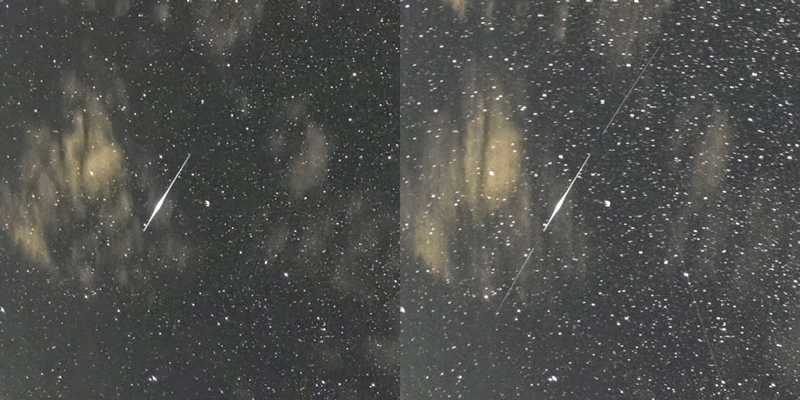
There were also a number of these flashes resembling bright meteors at first glance:

bright flash
8/12/23 20:21 PDT
Anza, CA
However there were invariably trails across several consecutive 20 second captures establishing them as slow movers compared to meteors:


I'm guessing this is a starlink panel reflecting sunlight right at my location, but it does not show up in the heaven's above site.  

Lastly, this frame caught my eye due to the similarity between the "star clouds" in the milky way (star field so dense that stars can't be distinguished as points) and the more mundane water-droplet-in-the-sky type:

Clouds in Space and Sky

Here's a cleaner version of the milky way, my best close up to date:

Milky Way Crop
8/12-13/23
Anza, CA

imaging details:
5/12-13/23 10 PM to 5 AM
Anza, CA
passing clouds
nikon D850
Sigma 15mm F/2.8 EX DG fisheye
20 sec, iso 1600

milky way second image stacked 144x20 sec raw .NEF files in Registar which did an amazing job correcting field curvature, processed in Maxim and Photoshop.  The posted image is 25% of full size