Try increasing gamma if dark sections aren't distinguished

Try increasing gamma if dark sections aren't distinguished

Thursday, September 14, 2023

perseid close up highlights

 a few highlights at a uniformly larger scale:

longest
warped by fisheye lens field curvature
and surrounded by green air glow
as it skimmed by low on the horizon
8/12/23 21:43 PDT

shortest
bright, but very foreshortened
coming almost straight in
8/13/23 03:02 PDT

The reason for the color is complex.  I thought it was simple black body radiation, but these are really only red and green.  ionization of the atmosphere occurs as the meteor burns up: the heated air glows red or green due to oxygen and nitrogen.  a similar phenomenon is involved in auroras and sky glow.  this can be be influenced by the speed and altitude of the meteor.  the composition of the meteor can also play a role as different metals can glow at different colors.  


cloud cutter
8/13/23 02:54 PDT

passing andromeda (upper right)
8/13/23 02:02 PDT

Double?
not sure on the left one
8/13/23 01:58 PDT

slide show of the bright ones:


residual ionized glow after anza house skimmer:
close inspection shows a faint trail left in the frame after the meteor appears
which gradually rises up in subsequent frames
would that the lights had been out :(
8/12/23 23:06

another:
faint trail left in the frame after the meteor appears
which gradually rises up in subsequent frames
8/13/23 00:12

the next night, dave kodama caught a really bright one here

imaging details:
5/12-13/23 10 PM to 5 AM
Anza, CA
passing clouds
nikon D850
Sigma 15mm F/2.8 EX DG fisheye
20 sec, iso 1600


Sunday, September 10, 2023

Perseids 2023

perseids wide field 8/12-13/23
north lower right
radiant at perseus right side

having repeatedly tried and failed to catch any meteor images in my back yard over the past few years, i elected to go out to the Orange County Astronomers dark sky site in anza to image this year's perseids with near new moon conditions.  

Burn line from recent fires near OCA site
Dave Kodama's cameras ready to go
OCA regular heungsoo choi in action


perseid buzzing OCA's anza house 8/12/23 23:06

while i've seen meteor showers from dark skies, including Yosemite and Yellowstone parks, this was in many ways the best.  others have had more frequent bursts, but these were typically faint white lines.  this night's show was filled with bright orange streaks.  by no means a meteor storm--the bright one's trickled in, but there were more than i've ever seen.  over the course of 7 hours, even with passing clouds, my camera captured 21 bright meteors.  they were rainbow colored in the camera, changing from red to green as they heated in the atmosphere, despite an orange visual appearance.  

perseid 8/13/23 00:50 local time

there were many faint meteor candidates, but  they were difficult to confirm due to abundant satellite traffic.  i only included bright streaks that were colored and directed towards the radiant in perseus. 

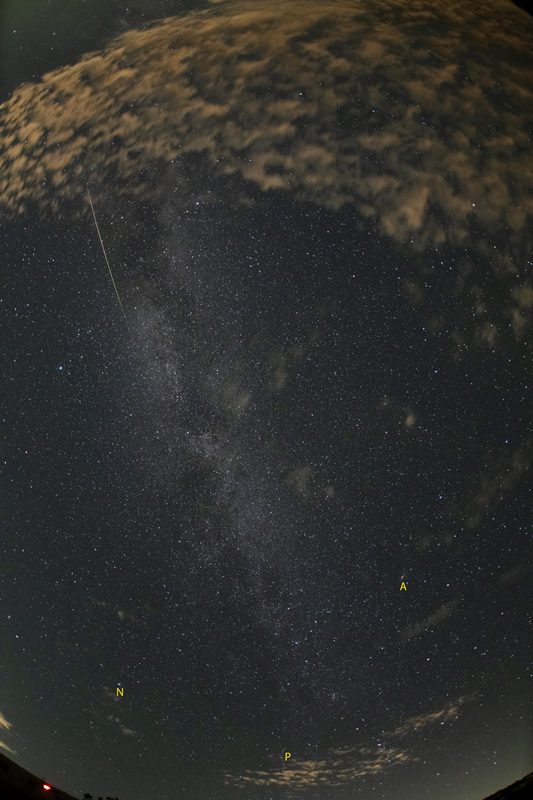
I used a fisheye lens to capture a wide swathe of sky, nearly horizon to horizon:

milky way center, perseid top left
N-north star, A-andromeda galaxy, P-constellation perseus
northern horizon bottom left
southern horizon top right
SUV bottom right :(
8/13/23 00:50 local time 

sadly, there were clouds passing through many of the images, making a composite difficult.

Star trails 8/12-13/23
polaris, north star lower left
anza house bottom left corner
my annoying SUV side light bottom right corner
southern horizon top right corner
(click for larger size)

typical recommendations are to just sit back and look up to view meteors. 
meteor shower observing accessory

the distribution in this capture was skewed towards the radiant in perseus on the horizon.  however, many of those were foreshortened with longer streaks on the opposite horizon.  

perseid distribution map 8/12-13/23
(click for larger size)

the best time to view meteors is between midnight and dawn.  i've also read 4 AM.  

a steady stream with clusters at 2AM and 3AM

imaging details:
5/12-13/23 10 PM to 5 AM
Anza, CA
passing clouds
nikon D850
Sigma 15mm F/2.8 EX DG fisheye
20 sec, iso 1600

missed the first hour as i set the camera delay to 20 minutes instead of 20 seconds between shots :(

the last meteor was caught at 5 AM, after astronomical dawn.  i saw several bright meteors as i was setting up, so i should have started imaging much sooner despite the "after midnight" recommendations.  

Sunday, July 23, 2023

Venus and Mercury

took another crack and venus and mercury.  unfortunately seeing was not great...

Venus 4/16/23 02:43 UTC
IR pass 850nm

Mercury 4/16/23 02:33 UTC
IR pass 850nm

i decided image venus during the day (venus is bright enough to see in broad daylight, it's just really hard to find) for 2 reasons: 

-all other things being equal, the seeing should be better with the planet at higher altitude 

-i was hoping to capture motion of venusian clouds by imaging over a long period of time.  

sadly it was a total bust. imaging runs over 20 minutes captured no cloud detail whatsoever (until earthly clouds obscured my view).  perhaps a hint of something towards the upper half as venus got lower in the sky:

Venus 4/17/23 00:36 UTC
UV

Venus 4/17/23 00:05 UTC
IR pass 850 nm

at a recent meeting of the OC astronomers, Chris Go (who admittedly doesn't image venus) suggested that sunlight saturates the daylight sky with UV ruining the detection of clouds.  or perhaps it was just a clear day on venus ;)

I have captured cloud detail in the past with this set up at twilight:

venus UV clouds


Image details:
camera ZWO ASI 290MM 
filters: ZWO IR pass 850, Baader U-filter bw 320-380nm
celestron 11" Edge HD
East Bluff, CA

4/16/23
mediocre seeing
02:43 UTC
2x barlow
IR pass 850 filter:

venus
FPS (avg.)=215
Shutter=0.746ms
Gain=351 (58%)
Frames captured=69635

mercury
02:33 UTC
2x barlow
FPS (avg.)=116
Shutter=3.281ms
Gain=436 (72%)
Frames captured=12765

4/17/23
Venus 
no barlow as UV is faint
mediocre seeing

UV filter:
00:36 UTC
FPS (avg.)=217
Shutter=2.055ms
Gain=351 (58%)
Frames captured=39233 

IR filter:
00:05 UTC
FPS (avg.)=42 ?!
Shutter=0.191ms
Gain=351 (58%)
Frames captured=12865