Try increasing gamma if dark sections aren't distinguished

Try increasing gamma if dark sections aren't distinguished

Sunday, November 7, 2021

solar stuff

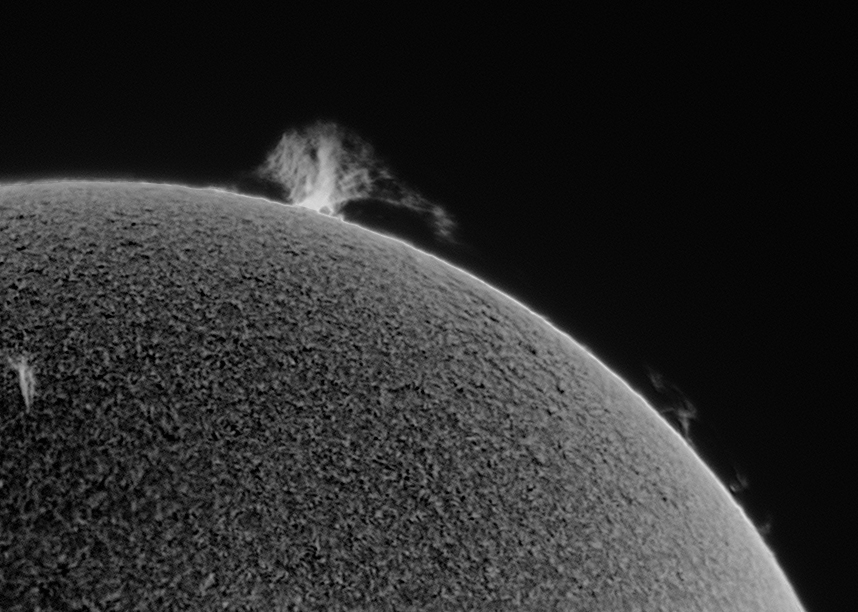
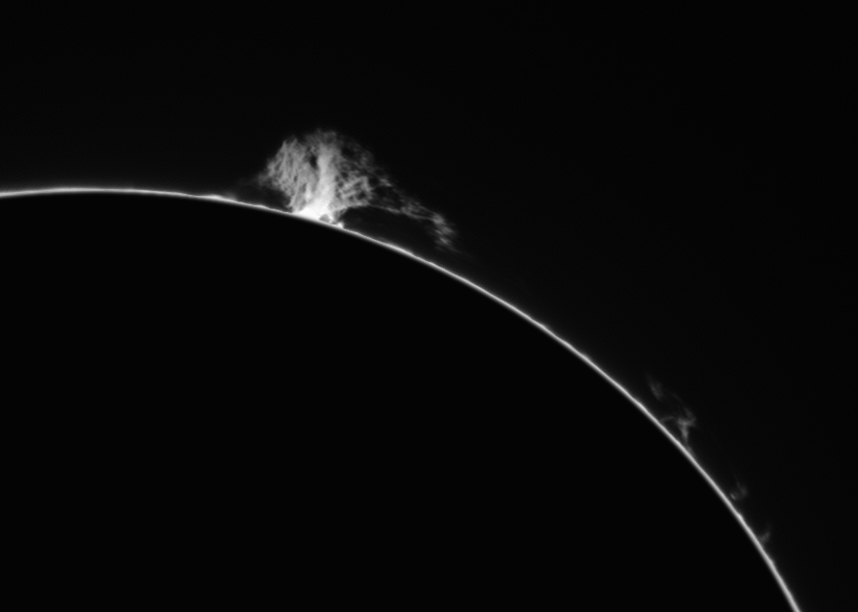
Solar Prominence Ha 
8/15/21 18:20 UTC

 
Solar Prominence Ha 
8/15/21 18:20 UTC
Exclusion

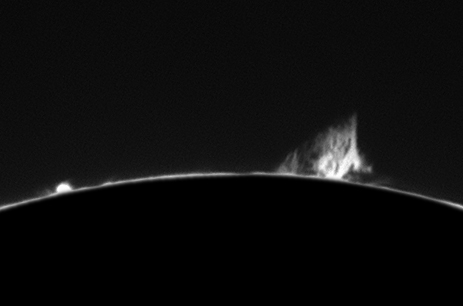
Solar Prominence Ha 
8/15/21 18:32 UTC
smaller prom from the side of the disk (rotated up)

There was a lot of excitement in the solar community this week due to a series of solar outbursts directed at the earth, some massive.  I actually caught the beginning of one visually on 10/28, but did not take pictures.  according to spaceweather.com a cannibal coronal mass ejection (fast moving coronal mass ejection, running into a slow moving one) hit the earth creating auroras visible as far south as 39 N in central california; detectable in cameras as far south as joshua tree. 

it was of course cloudy here so i missed it all as well as the taurid meteor shower and the new moon :(

The images above show a pretty big solar prominence i captured on 8/15/21 and have absolutely nothing to do with the events described ;)


Image details:
Ha Lunt 60 PT double stacked
zwo ASI 290MM
manual tracking on alt-azm mount
20 sec captures
FPS (avg.)~93-178
Shutter~0.331-2.283 ms
Gain=351 (unity)
East Bluff, CA
8/15/21 18:20, 18:32 UTC

Saturday, September 18, 2021

Jupiter got smacked

the astronomy community was abuzz last week when an amateur astronomer in Brazil captured video of a  bright flash as a meteor estimated at 100 m crashed into jupiter.  At least 10 other observers independently observed the event, making it the most observed impact on jupiter to date; the eighth recorded since the first was observed in 1994.  More information can be found in this sky & telescope article

Had the meteor struck earth it would have been equivalent to 34 megatons of TNT (hiroshima was 15 kilotons).  Jupiter's massive gravity is thought to protect earth from many of these collisions.

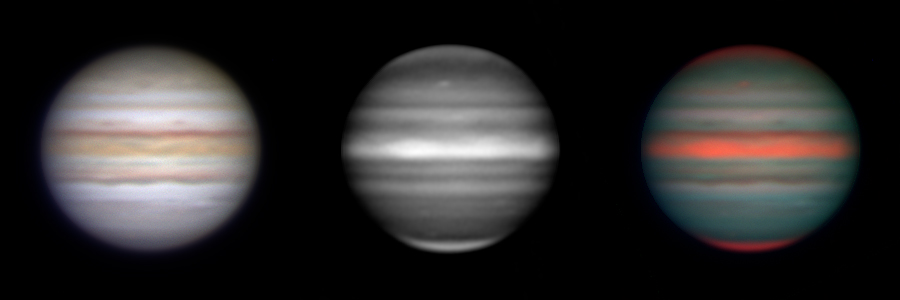
Despite the fact that observers were not able to find any residual storms (which have been sighted after prior impacts), i decided to check out the impact site with a methane filter.  unfortunately, the Jupiter Central Meridian calculator cited in the article is now defunct and spat out the wrong data--so i completely missed the site (holy homophones).  nevertheless i got some colorful pictures of jupiter:

Jupiter 9/16/21 04:38 UTC.  RGB left, Methane center, Methane as red, GB right

Imaging details:
camera ZWO ASI 290MM with ZWO RGB filters
Baader methane 889 nm 8 nm bandwidth
celestron 11" Edge HD, no barlow
East Bluff, CA
90 second captures, 2x binning for methane
gain 351, exposure ~0.6-1.0 ms, 30% histogram, ~280 fps
methane exposure 375 ms, 2 fps

Tuesday, September 14, 2021

a rocket at night: falcon 9 launch 9/13/2021

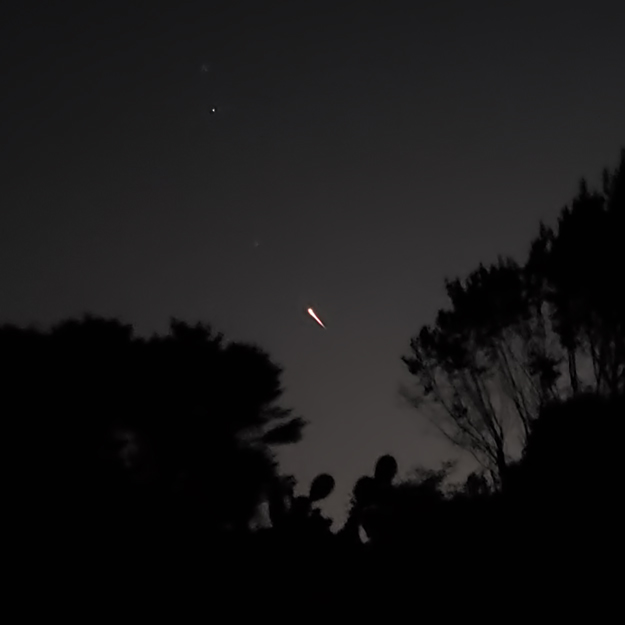
visually it was a spectacular event, there was something surreal about seeing the long bright orange rocket plume slowly rising up through the trees.  it looked very...well rocket-like.  perhaps we'll be used to it in years to come.  perhaps residents closer to vandenberg are already used to it--tired of it?

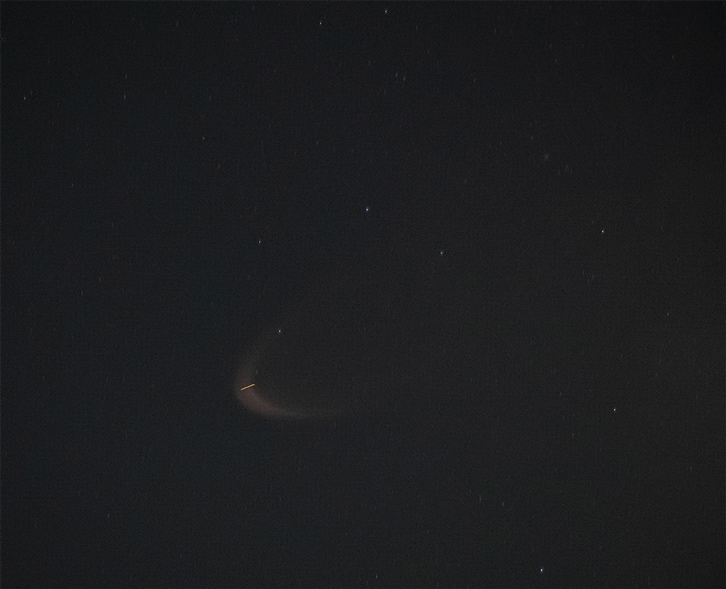
 Unfortunately, my images were pretty much a bust, but here are a few salvages, the best from my cell phone:

Falcon 9 from Coastal Peak Park 9/13/2021


image details:
Samsung Galaxy Note 9
f/1.5, 1/4 sec, 4 mm
Nikon D850
Nikon Nikkor AF-S DX Telephoto Zoom 55-300mm f/4.5-5.6G ED VR
f/4.5, 2 sec, iso 5000, 55 mm

much processing in photoshop to correct star trailing due to camera shake as my remote wasn't working.