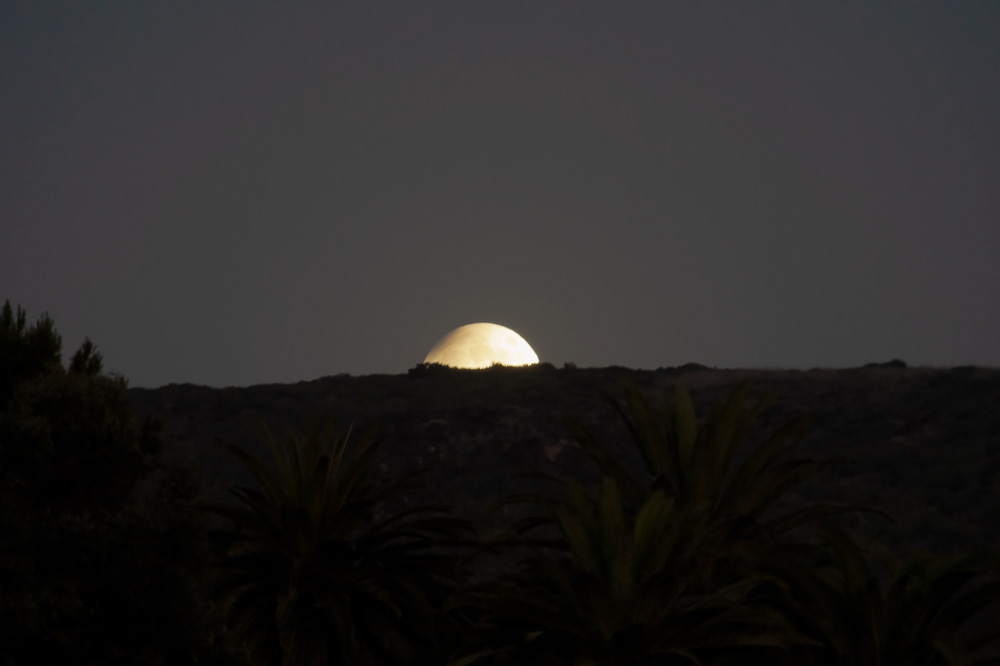
Try increasing gamma if dark sections aren't distinguished

Try increasing gamma if dark sections aren't distinguished

Saturday, June 21, 2025

neighborhood falcon

the neighborhood turned out for a twilight falcon launch (click on the arrow twice to start the video--the audio is priceless):


first stage shut off:


second stage cruising:

the two small trailing dots are the fairings and the third further back is the first stage
the first stage will land on a barge and the fairings recovered at sea

second stage poofing out:


into the palm trees:


late second stage between the trees and into space:


thanks to Gregg for hosting the neighborhood viewing 
(OK maybe not the whole neighborhood, but it was more than just gregg and me so that counts)


In a separate note there's a new cloudy nights t-shirt at astronomics
(cloudy nights is the ultimate web site for amateur astronomy, sponsored by astronomics)
while you may or may not want the iconic grey shirt
the "pitches" on the web site are priceless with the writer channeling J Peterman
so for all you fans of Seinfeld and astronomy (you know who your are)
you must go to the web site and check out the pitches
https://astronomics.com/collections/cloudy-nights-t-shirts/products/cloudy-nights-short-sleeve-t-shirt


imaging details:
6/16/25 8:41-8:44 PM local
Eastbluff, CA
Gregg's front lawn
Samsung galaxy S22 ultra

audio transcript of video:
young child's voice brimming with enthusiasm
"come here quick..."
then softly as if to avoid disturbing the rocket
"...it's right over our house"


in case the pitches go away (from astronomics web site above):

First try...

The Cloudy Nights T-Shirt
(Now with 47% more mystique.)

It was the spring of 1997. Somewhere between the Mojave and a memory, a man named Skip Donnelly sat cross-legged in the back of a rust-orange VW van, peering through a hand-polished 6" Newtonian and waiting for Hale-Bopp to clear the horizon.

He hadn’t slept in three nights. He’d been living off gas station trail mix and a dream. His only companion? A local coyote who seemed to admire his collimation skills.

Skip wore this shirt—or one eerily similar.

It’s Graphite Heather, though he’d just call it “night sky gray.” Softstyle fabric with the kind of 65/35 poly-cotton blend you could sleep in on a moonlit truck bed. It absorbed both dew and regret in equal measure. By morning, the comet came. Bright. Relentless. Eternal.

Skip wept.

He never made it back to Phoenix. Some say he followed the comet, westbound. Others claim he founded a secret astronomy club in Taos that meets only during solar minimum.

We can’t say for sure. But we can say this:

You don’t just wear the Cloudy Nights T-Shirt.
You inherit it.

Second try...

The Cloudy Nights T-Shirt

It was 2:17 a.m. in the high desert of New Mexico.

A lonely astronomer stood beside his Dobsonian like a sentry, hand wrapped around a thermos of coffee that had long since gone cold. Above him, Saturn hovered like a jeweled ringbox in a sea of ink. His fingers trembled—not from the chill, but from awe. And the shirt he wore? It wasn’t just a shirt. It was a declaration.

This is that shirt.

Crafted from a supple blend of 65% polyester and 35% cotton, this Graphite Heather short sleeve garment has seen things—cosmic things. It breathes like a mountain breeze and fits like the warm memory of your first clear sky chart. The logo is discreet, like a secret handshake at a Messier Marathon. The fit is modern, but forgiving. The cut, understated but purposeful.

Available in sizes Small through 4XL for observers of every focal length and flange distance.

You don’t just wear the Cloudy Nights T-Shirt.

You live in it.

And now the one that makes sense to just about everyone.


Cloudy Nights Short Sleeve T-Shirt – Graphite Heather

Show your love for late nights, clear skies, and the community that helps you navigate them both. This official Cloudy Nights t-shirt is printed on a soft, breathable Gildan Softstyle tee in a versatile Graphite Heather color. Whether you’re polar aligning at dusk or just grabbing coffee in town, it’s a comfortable way to rep the world’s largest astronomy forum.

Made from a durable 65/35 polyester-cotton blend, this shirt holds its shape and stays comfortable through long nights and many washes. Lightweight, soft, and just structured enough to keep from looking like a wrinkled star chart.

Available in sizes Small through 4XL—because we support big scopes and big style alike.

Sunday, April 20, 2025

stupid venus tricks--inferior conjunction

Venus inferior conjunction
3/22/25 3:21 PM local
22:21 UTC
1% illuminated
8 degrees 25 minutes from the sun

when you see a really really bright star in the early evening it's probably venus.

and when you see a really bright star in the early morning it's probably...venus.  

every 19.5 months (approximately) venus laps earth, 
passing  between the earth and the sun, 
usually just missing the sun, 
switching from the evening to the morning star.  

this event is called the inferior conjunction of venus (with the sun), the superior conjunction occurring on the far side.  

the cool thing about the inferior conjunction is that the crescent is a thin as it can possibly get.  if the separation from the sun is small enough, the crescent may even go more than half way around the disk due to atmospheric refraction*

this gives rise to a stupid venus trick: 
observe (or photograph) venus in the middle of the day when it is as close to the sun as possible.  needless to say, this is DANGEROUS.  one glimpse at the sun through a high power telescope is likely to fry your retina, melt optics, or possibly explode telescopes.  so one needs to be very careful.  

the inferior conjunction before last was hampered by clouds. i caught a quick visual glimpse, but didn't have time for an image.  

last time it was hot, sunny and very windy.  my goto wasn't working well and a lens cap blew off while i was centering on the sun, causing an unplanned modification of my finder scope, leading me to abandon the attempt:

hole burnt in finder-scope lens cap
it's actually pretty handy

this time i caught it (above), though sadly, i did not catch a more circumferential crescent.  

venus transits (crossings directly across the face of the sun) are extremely rare, the last was in 2012, and next will be 2117.  and yes venus is retrograde when this occurs for you astrologers.  

i was fortunate enough to catch the rare 2012 transit with a brand new solar telescope:

venus transit 
6/5/2012


*i think

more on venus inferior conjunctions:
https://earthsky.org/astronomy-essentials/superb-venus-inferior-conjunction/
https://earthsky.org/astronomy-essentials/inferior-conjunction-venus-between-sun-and-earth/
https://skyandtelescope.org/astronomy-news/venus-sprints-from-evening-star-to-morning-star/

image details:
ZWO ASI290MM
Baader 685 nm IR pass filter
celestron 11" Edge HD, no barlow
East Bluff, CA
2025-03-22 22:21.2 UTC
180 second capture
Shutter=0.069ms
Gain=306 (51%)
Histogramm=80%
FPS (avg.)=289
captured with firecapture
stacked in autostakkert
processed in registax and photoshop
used neither ADC nor barlow
processing was difficult as faint passing clouds led to variation in image brightness, making it difficult for stacking software to pick out the low contrast crescent against the very bright sky.  only one capture could be aligned. 
colorized background to natural sky in photoshop

Monday, February 10, 2025

A city falcon

 stepped out the door of my office after work and caught this:

falcon-9
Long Beach, CA
2/10/25 6:12 PM local


falcon-9 passing venus

falcon-9 about to run the light


city contrail


video excerpts


short video 


image details:
2/10/25
6:12-6:17 PM local
Long Beach, CA
Samsung galaxy S22 ultra
wide view:
f2.2 1/24 s 13 mm ISO 2500
variable on video


Tuesday, February 4, 2025

last weekend's moon-venus conjuction

many noticed the conjunction of the moon and bright venus after sunset last weekend.  turned my planetary rig to venus, but failed to detect any clouds.  

moon-venus
telescope-camera
saturn below, just above the tree line
2/2/2025 8:40 PM local

Conjunction close up:

moon venus conjunction
composite image to include earthshine
6:23-6:25 PM local

Venus Close up.  sadly failed to detect any surface cloud structure:

Venus UV filter
2025-02-02 01:57 UTC


Moon at same scale for no good reason:

Moon
2/2/25 6:23 PM

Imaging details:
2/2/2025
Eastbluff, CA

venus close up
ZWO ASI664MC
celestron 11" Edge HD, no barlow
East Bluff, CA
2025-02-02 01:57 UTC
180 second captures
Shutter=0.820ms
Gain=351 (58%)
Histogramm=88%
FPS (avg.)=866 !
captured with firecapture
stacked in autostakkert
processed in registax and photoshop
used neither ADC nor barlow for fear of blocking UV

venus moon conjunction
nikon D850
F-S DX NIKKOR 55-300mm f/4.5-5.6G ED VR
1 minute video captures
stacked in autostakkert
processed in registax and photoshop
images used for composite:


Sunday, January 19, 2025

Comet C2024 G3 Atlas survives

Comet C2024 G3 Atlas survived it's close pass with the sun, causing a stir in the astronomy community as comets surviving such a trip tend to be very bright.  some, even visible during daylight.  
While this one was in theory bright enough to see during daylight, it's trajectory kept its line of sight close to the sun and heading south.  so not a great target for northern viewers due to the sun's glare.  

On 1/15/25 I managed to catch it from the top of signal hill shortly after work.  It was visible in binoculars, slightly better than this image, but not visible naked eye:
C2024 G3 Atlas
1/15/2025 
approximately 5:41 PM local

Wider view:
C2024 G3 Atlas
1/15/2025

About 30 people were gathered on top of signal hill to catch the sunset (none for the comet).  As amateur astronomers are wont to do, I attempted to share my catch with my neighbors: handing off the binoculars to a couple next to me, I told them to look above the string of lights heading up the far hill...
after a few failed attempts, I showed them again and they found it, at least pretending to be pleased.  
In running through my images, I discovered the problem: there were intermittently more than one string of lights "going up the hill" and they were moving--massive arrays of lights working at the port of Long Beach.  
Comet C2024 G3 ATLAS
Activity at 
Port of Long Beach
1/15/2025 
5:41-5:47 PM


image details:
1/15/2025
Hill Top Park, Signal Hill.
comet first detected in binoculars at 5:41 PM local, approximately 36 minutes after sunset.
smoke from the LA fires darkening horizon.  
not visible naked eye.  

nikon D850
F-S DX NIKKOR 55-300mm f/4.5-5.6G ED VR
1/25 sec @ f/5 ISO 400 195 mm


Saturday, January 4, 2025

second jupiter of the year 2025-01-03 05:39.2 UTC

 still more good seeing, this time through light fog.  

The great red spot can be seen just peaking off the right side (better shown in the animation below).  There appears to be a long tail of turbulent clouds "following" the GRS in the brown southern equatorial belt.  


Animation:

2025 01 03 05:32.9-05:45.6 UTC


initial view for winjupos orientation caught detail on Ganymede:

Jupiter and Ganymede
2025-01-03 05:28.8 UTC

Imaging details:
exposures were 2-3 times longer than normal due to light to moderate fog

Thursday, January 2, 2025

first jupiter of the year 2025-01-02 06:03.2 UTC

another night of good seeing, managed to get the barlow out for 2x magnification before the fog rolled in

first of the year
technic
ally 1/2/25  06:03.2 UTC
but it was 10 PM on January first local

Jupiter
2025-01-02 05:57-06:10 UTC

Sadly, fog totally obscured mars later in the evening.  

imaging details:
above
the animation is composed of individual captures
couldn't resist pushing the processing a bit hard as the data was pretty good
difficulty tuning the eADC now with the barlow because the numbers are so damn small
will try installing the software
sadly the instructions call for arcane knowledge of driver installation.  


Wednesday, January 1, 2025

Happy New Year. Jupiter 12/31/24 3:48.6 UTC

happy new year all.  


the region between the 2 blue festoons was blazing away through medium to heavy fog.  

you can also see a recent storm in the southern equatorial belt (white patch to the right of the lower of the two thick tan bands)


Image details:
see annotations
best 4 of 9 capture attempts over a 10 minute period.  
the image was upsampled 3x, processed then reduced to 50%, so 1.5x from native.
conditions have been tough recently, either terrible seeing, clouds or heavy fog.  i've often noted the seeing can be excellent when it's foggy, but there's usually a very short window to image before total fog out, with the challenge of massive dew formation.  this one was captured through breaks in the fog with the dew heater on max.  The region was never totally clear and completely fogged at times.  had to feather the exposure time during captures to keep the exposure reasonable.  The lowest exposures were still 3x that of a clear night, going up to 10x. used virtualdub to delete overexposed frames (PIPP didn't work).  

Sunday, December 1, 2024

Jupiter, Ganymede shadow transit 11/10/2024 08:41.5 UTC

Here's Ganymede's shadow transiting Jupiter on 11/10/24:

Jupiter
2024-11-10 08:41.5 UTC

My goals for the evening were quick test shots of saturn and jupiter 
saturn was disappointing with mediocre seeing at low altitude,
but when i turned to jupiter the seeing improved dramatically
this combined with the GRS and a Ganymede shadow transit led to sleep deprivation.

Here's an animation of a portion of the shadow transit:

Jupiter
2024-11-10
08:24.8 to 08:48.6 UTC

wide view:

Jupiter and moons
2024-11-10
08:19.9 UTC
Saturn and moons earlier that night:

Saturn and a few moons 
2024-11-10
07:09 UTC


Imaging details:
ZWO ASI664MC
sunobserver eADC from astro hutech
celestron 11" Edge HD, no barlow
East Bluff, CA
11/10/24
90 second captures
Shutter=1.000 ms
Histogram=61%
gain 431
245 fps

captured with firecapture
stacked in autostakkert (upsampled 3x)
combined in winjupos 
processed in registax and photoshop
down sampled 50% for a final 1.5x for the first shot
1x for the animation
.5x for the wide field.

saturn was imaged low in the sky earlier that evening
the seeing was mush down low, but the eADC did well.  

This was my third night out with the eADC
the first required a bit of fiddling learning the controls/modes
the numbers on the readout are comically small. 
i had to magnify it with my cell phone
the alignment was good, but not perfect. 
the second night i dialed in the alignment perfectly, but the seeing degraded.
the third night, i just plugged the thing in, 
didn't touch the controls 
the correction was perfect all across the sky.  
very impressive.  

The ADC tuning tab in firecapture helped align the ADC:


winjupos continues to show it's value:  
the image derotation section has an option to correct the position of planetary moons and their shadows.
this allows you to stack individual moon images in one fell swoop with image derotation.  
hence more apparent detail on ganymede than i've ever captured before.
the shadow stacking didn't work out as well, leaving some artifacts (removed in photoshop), but it did mask the shadow out from all the images not at the reference time, so a help there.
here's a winjupos screen shot accurately showing distortion of the shadow on the edge of jupiter and even the penumbral halo:

winjupos screen shot showing
ganymede and shadow positions


Sunday, November 3, 2024

carpe noctem, saturn leads the planet parade

depressed about the time change?
get out there and enjoy the night.  
saturn is perfectly located for early evening viewing
followed by jupiter in december
then mars opposition in january

enjoy

Saturn 
10/21/24 06:07 UTC

Imaging details:
first light new camera and eADC

the ZWO ASI664MC
an upgrade from the 290MC
the frame rate was 50% higher for this image
sensitivity theoretically higher as well.  

the sunobserver eADC from astro hutech is an electronic atmospheric dispersion corrector
that uses an accelerometer to adjust the correction angle as the scope rotates across the sky
eliminating the need to correct the ADC throughout the night
very nice for a long session, though i have to say the numbers on the read out are comically small. 
i had to magnify it with my cell phone
while i have no problem with this small type.  

celestron 11" Edge HD, no barlow
East Bluff, CA
10/21/24
05:53-06:21 UTC
17 x 90 second captures
Shutter=2.347ms
Histogram=31%
gain 431
300 fps

captured with firecapture
stacked in autostakkert (upsampled 1.5x)
combined in winjupos 
processed in registax and photoshop


Monday, October 28, 2024

Comet C2023 A3 Tsuchinshan–ATLAS wrap up and an aurora fail

Stacked my comet images to see if i could pull out the anti-tail...no luck :( though you can see a bit more of the tail, especially to the right compared to the single frames.  

comet C2023 A3 Tsuchinshan–ATLAS
10/12/2024 7:23 - 7:30 PM Local
average of 119 images

Here's a cell phone shot of the "football field" with a few OCA members in action

comet C2023 A3 Tsuchinshan–ATLAS
10/12/2024 7:29 PM Local
Anza football field

A closer cell phone view approximating the field of my D850 shot
comet C2023 A3 Tsuchinshan–ATLAS
10/12/2024 7:30 PM Local
Anza


Lastly I took a "shot in the dark", trying to catch the 10/10/24 aurora from my backyard in east bluff.  no hint of the aurora (not unexpected being just south of John Wayne airport).  made some star trails for fun:
Star Trails 10/10/2024


Image details:
comet
10/12/24 19:23-19:30 local
Orange County Astronomers site
Anza, CA
nikon D850
F-S DX NIKKOR 55-300mm f/4.5-5.6G ED VR
2.5 sec @ f/4.5 ISO 1600 55 mm
119 x 2.5 sec average combine

wide fields
samsung galaxy S22 ultra
23 mm f/1.8 1/2 sec ISO 2000

star trails
nikon D850
Sigma 15mm F/4.5 EX DG fisheye
not sure on settings, maybe 4 sec, iso 1600


Sunday, October 13, 2024

Comet C2023 A3 Tsuchinshan–ATLAS


comet C2023 A3 Tsuchinshan–ATLAS
10/12/2024 7:24 PM Local

Went out to anza saturday to catch the comet.  as the beautiful pink of sunset faded, i was worried it was going to be a bust, but at 7 pm (40 minutes after sunset) i caught a faint glimpse.  it continued to improve over the next 20 minutes then gradually faded as it set.  i could see a vertical streak visually, only slightly better with averted vision.  7x50 binoculars showed a bright nucleus with a large slightly fan shaped tail, close to the photo above.  15x50 IS binoculars gave a bit better view of the core, but the field felt too small.


Animation:

large animation
click on full size if you have the band width:


Image details:
10/12/24 19:24-19:34 local
Orange County Astronomers site
Anza, CA
nikon D850
F-S DX NIKKOR 55-300mm f/4.5-5.6G ED VR
2.5 sec @ f/4.5 ISO 1600 55 mm
will try stacking, but i'm not optimistic that it will work with the changing background sky

Edit:
corrected comet name from C/2024 to C/2023


Saturday, September 28, 2024

super moon, tiny eclipse 9/17/24

Here’s a partially eclipsed supermoon rising on the evening of 9/17/24.  I happen to have 8 PM dinner reservations at beachcombers, so I headed down to a section of crystal cove with a nice view to the east a bit early to catch it.   

Partially eclipsed supermoon
9/17/24 7:17 PM

As a bonus, i caught a green flash at sunset (confirmed by 4 others), first i've ever seen from California.  sadly no pics.  I will note that as the sun was setting it seemed to be melting into the water at the bottom, suggesting the highly refractive conditions necessary for a green flash.  

a few more shots:

Partially eclipsed supermoon
9/17/24 7:19 PM

Partially eclipsed supermoon
9/17/24 7:19 PM

attempted a few composites combining long and short exposures:

Partially eclipsed supermoon
composite of long and short exposures
9/17/24 7:22 PM

Partially eclipsed supermoon
composite of long and short exposures
complete with crystal cove sign
9/17/24 7:24 PM

imaging details (most people should stop here):
Crystal Cove State Park Vista Point
9/17/24 7:17 to 7:24 PM
nikon D850
F-S DX NIKKOR 55-300mm f/4.5-5.6G ED VR
hand held, balanced on tripod--forgot connector :)
exposure details in order:
1/10 sec @f/9 ISO 1250 300 mm
1/25 sec @f/9 ISO 1250 300 mm
1/125 sec @f/9 ISO 1250 300 mm

for the composites, i tried to portray the visual experience by combining long and short exposures in photoshop, showing a bit of the night scape and the bright glow surrounding the moon while preserving the detail of the lunar surface.  I also stamped out some pesky street lights.  
1/2 sec @f/9 ISO 1250 155 mm


1/2 sec @f/9 ISO 1250 55 mm

30 sec video capture 1/1000 sec ISO 3200 30 fps @ 300 mm
stacked in autostakkert,
sharpened in registax


Sunday, September 8, 2024

Last weekend's loop de loop 9/1/2024 20:06 UTC

Last weekend (Sept 1st 2024) there was a large coronal mass ejection / flare off of the rim of the sun, followed by post flare loops that lasted for hours.  missed the flare, but caught the loops.  

Solar Prominence 2024 09 01 20:06 UTC

10 minute animation
Solar Prominence 2024 09 01
19:59 - 20:10 UTC

A few minutes on the little guy

Solar Prominence 2024 09 01

Image details:
Eastbluff, CA
2024 09 01
19:59 - 20:10 UTC
M class flare peaked at M5.57 south of AR3811 followed by persistent loops
Ha 
Lunt 60 PT B1200 
manual guiding with alt-azm mount
zwo ASI 290MM
20 second captures
FPS (avg.)=183
Shutter=2.163ms
Gain=351 (58%)
best 25% frames
autostakkert, registax, photoshop
aligned and manually de-rotated in photoshop

here's an autoalign in photoshop without derotation
Solar Prominence 2024 09 01
19:59 - 20:10 UTC

after tedious manual derotation/alignment
Solar Prominence 2024 09 01
19:59 - 20:10 UTC
manual alignment and de-rotation


Loop the loop